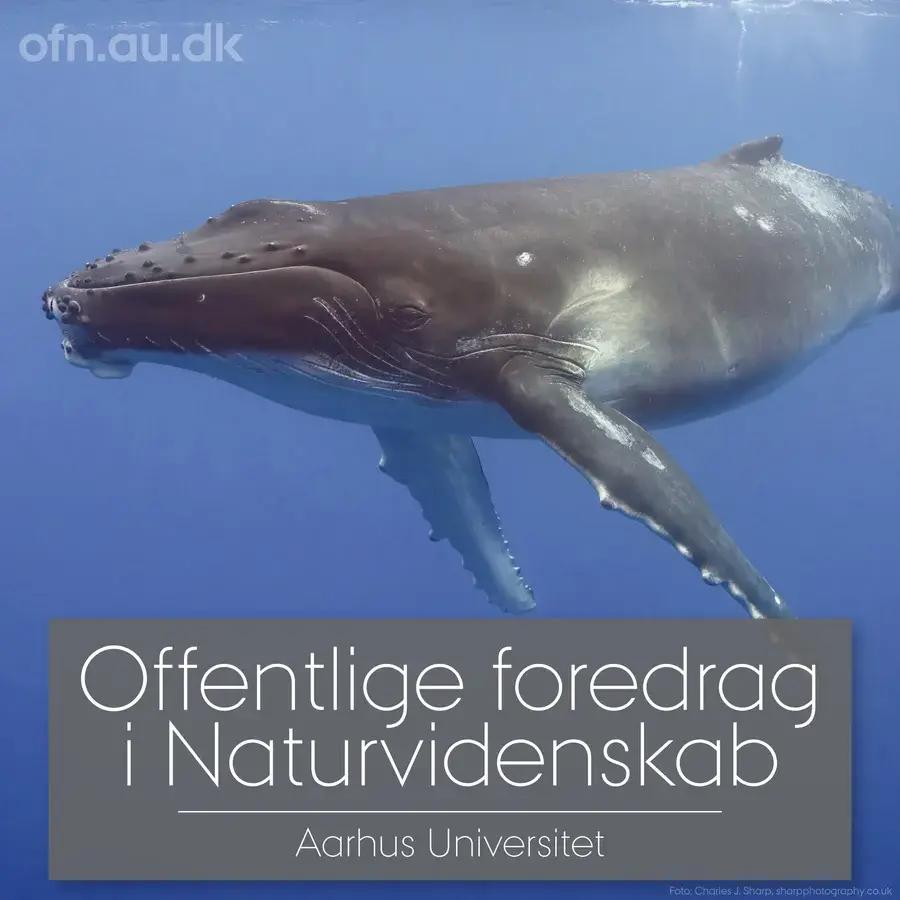
Earth's largest animals live hidden in the world's oceans, but modern technology has now opened entirely new possibilities for understanding these fascinating giants. An updated lecture about whales and the research behind their secret underwater lives.
Whales are among the most remarkable mammals with extraordinary adaptations to life in water. Today we recognize that ocean ecosystems are completely dependent on whales as apex predators — a far more valuable role than they were previously seen in, when they were hunted to near extinction. New tools such as drones and measurement equipment with suction cups now give researchers the opportunity to study whale biology while they hunt at great ocean depths, far from the surface where they could previously only be observed.
The lecture takes you on a thrilling journey through the seas. You meet the porpoise — the world's smallest whale — hunting in Danish waters, see deep-sea cameras document the sperm whale's hunting prowess at depths exceeding 1,000 meters, and learn about the Greenland whale's remarkable ability to survive in ice-cold water. You will also be fascinated by how a humpback whale mother can give birth to and nurse a calf without eating herself for an entire six months. Throughout it all, the thread of sustainable coexistence with these important apex predators in a changing world is woven together.
Practical information
- The lecture is streamed live from Aarhus University
- Part of the series "Public Lectures in Natural Science"
- Organized by Aarhus University in collaboration with hosts around the country and supported by the Carlsberg Foundation
- Free admission
- Location: Studenterhus Odense